How to Draft and Review a Collaboration Agreement With Grok Bot (Step by Step)
A beginner's step-by-step guide to using Grok Bot for a simple collaboration agreement: write the deal in plain words, get a clear first draft with blanks to fill, review the other side's edits, flag missing pieces, and know when to bring in a lawyer.
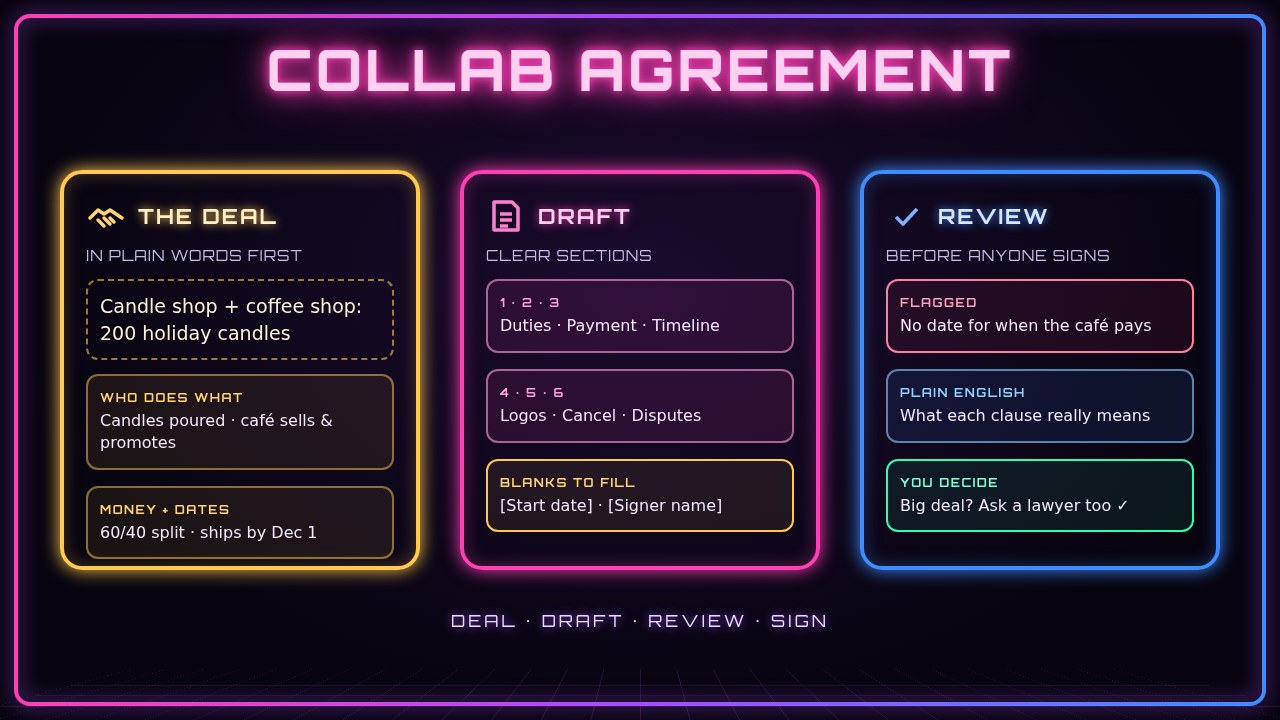
A handshake deal feels fine until someone asks, “Wait, who was paying for the boxes?” A short written agreement fixes that. In this guide you’ll use Grok Bot to draft a simple collaboration agreement and review it before anyone signs: put the deal into plain words, get a clean first draft with clear sections, fill in the blanks, check the other side’s changes, and spot what’s missing.
You’ll follow one running example: Rosa, who runs Juniper & Wick, a small Etsy candle shop. A local café, Bluebird Coffee, wants to team up on a holiday candle that smells like their house blend. Rosa will make 200 candles, the café will sell them at the counter and promote them, and Rosa will also sell them on Etsy. They’ve agreed on the basics over coffee. Now Rosa wants it in writing.
Important: Grok Bot can help you organize the deal, write a clear draft, and explain what a clause means. It is not a lawyer. For anything with big money, long commitments, or legal risk, use the draft to prepare for a short review with a real attorney.
What you need
- Grok Bot
- A simple collaboration you want in writing (a co-branded product, a sponsored post, a guest workshop, a photo shoot swap)
- The basics you’ve already agreed on: who does what, money, dates
- Optional: Google Docs connected if you want the draft saved there (the connect your apps guide shows how)
- About 30–45 minutes
1. Write the deal in plain words first
Don’t start with legal-sounding language. Start by telling Grok Bot what you agreed on, the way you’d explain it to a friend. Include anything you’re unsure about, too.
I want to put a small business collaboration in writing. Here's the deal in plain words:
- My shop: Juniper & Wick, a small Etsy candle shop (me: Rosa).
- Partner: Bluebird Coffee, a local cafe.
- We're making a co-branded holiday candle that smells like their house blend.
- I make 200 candles. I pay for wax, jars, and labels.
- The cafe sells them at their counter for $28 and posts about them on Instagram.
- I also sell them in my Etsy shop.
- Cafe sales: they keep 40%, I get 60%. Etsy sales are mine.
- Candles delivered to the cafe by December 1.
Not sure yet: what happens to unsold candles, and who approves the label.
Don't write the agreement yet. First, repeat the deal back to me as a simple summary
and list any questions we haven't answered.
What you should see: a short summary of the deal plus a list of open questions, like “When does the café pay you for its sales?”, “What happens to unsold candles after the holidays?”, “Can either side use the other’s logo outside this candle?”, and “What if the delivery is late?”
2. Answer the open questions
Go through the list and answer each one. If you don’t know, say so; Grok Bot can suggest common options. Rosa checks a couple of answers with the café owner by text before replying.
Answers:
- The cafe pays me for its sales every two weeks, by bank transfer.
- Unsold candles: the cafe can return them to me by January 15 and pays nothing for those.
- Label: we both approve the final label in writing (email is fine) before I print.
- Logos: each of us can only use the other's logo for this candle, through January 31.
- Late delivery: I'm not sure. What are 2-3 common ways small businesses handle this?
What you should see: your answers folded into the summary, plus a few simple options for the item you weren’t sure about (for example, “agree on a new date in writing” or “either side can cancel if it’s more than a week late”). Pick one.
3. Ask for a short, plain-English first draft
Now ask for the agreement itself. Ask for plain language, numbered sections, and blanks in brackets for anything not decided, so nothing gets made up.
Now write a short collaboration agreement based on our final summary.
Rules:
- Plain English, no legalese. Short numbered sections with clear headings.
- Sections: who's involved, what each side does, money and payment timing,
  timeline, label and logo use, unsold candles, late delivery, ending early,
  and signatures.
- Put anything we haven't decided in [brackets] instead of guessing.
- Keep it to about 1-2 pages.
What you should see: a one- to two-page draft with sections like “1. Who’s Involved”, “2. What Each Side Does”, “3. Money and Payment”, and “9. Signatures”, with blanks such as [Start date], [Bluebird Coffee owner’s legal name], and [Rosa’s business address].
4. Fill in the blanks
Ask for a list of every bracket in the draft, then answer them in one message. This keeps you from missing one buried in the middle.
List every [bracketed blank] in the draft, numbered, with the section it's in.Then reply with your answers:
1. Start date: November 30, 2026
2. Bluebird Coffee owner's legal name: [I'll add this after I ask them]
3. My business address: leave as a blank line for now
Please update the draft with these, and keep any that are still unknown in brackets.
What you should see: the updated draft and a short list of the blanks that are still open. It’s fine to leave one or two until you hear back.
5. Ask Grok Bot to check the draft for gaps
Before you send it, have Grok Bot read the draft like a careful partner would. Ask what’s missing, what’s unclear, and what could cause an argument later.
Review this draft like a careful small business owner would before signing.
Tell me:
- Anything missing that a deal like this usually covers
- Anything vague that two people could read two different ways
- Anything that seems unfair to either side
Don't rewrite the draft. Just give me a numbered list, most important first.
What you should see: a numbered list like “Section 3 says the café pays every two weeks, but not starting when,” “Who pays if a candle breaks on the café’s shelf?”, and “The draft doesn’t say who handles returns from café customers.” Decide which ones matter and ask Grok Bot to add them, one at a time.
6. Get a plain-English summary for the other side
A short summary makes the conversation with your partner easier. Ask for one you can paste into an email or text along with the draft.
Write a friendly 5-bullet summary of this agreement that I can send to the cafe owner
along with the draft. Keep it casual and end with: "Let me know if anything looks off!"
Don't send anything. Just show me the text.
What you should see: five short bullets and the closing line, shown in the chat for you to copy. If your email is connected, you can ask for it as a draft instead; nothing goes out until you send it yourself or tell Grok Bot to send it (see the email and calendar guide).
7. Review the other side’s changes
When the café sends back its version, attach the file or paste the text. Ask Grok Bot to compare it with your version and explain every change in plain words.
Here's the cafe's edited version of our agreement [attach or paste it].
Compare it with my last draft. For each change, tell me:
- What section it's in
- What it used to say and what it says now
- What it means for me in plain English
- Whether it's a small wording fix or a real change to the deal
What you should see: a list of changes, for example “Section 3: payment changed from every two weeks to once a month (real change: you get paid later)” and “Section 5: ‘logo’ became ‘name and logo’ (small wording fix).” This is your checklist for the reply.
8. Decide what to accept, then update the draft
Tell Grok Bot which changes you’re fine with and which you want to push back on. Ask for a polite reply that explains why.
Accept the wording fixes. I'm OK with monthly payments if they pay by the 5th of each month.
I don't accept the change making me pay for candles broken at the cafe.
Update the draft with that, and write a short, friendly reply explaining my two points.
What you should see: a new version of the agreement with your decisions in it, plus a short reply you can send. Read both yourself before anything goes out.
9. Run a final read-through before signing
Once you both agree, ask for one last check that the numbers, names, and dates match everywhere. Small mismatches are the most common mistake in a draft that’s been edited a few times.
Final check before we sign. Make sure:
- Every name, date, price, and percentage matches across all sections
- No [bracketed blanks] are left
- Section numbers and any references to other sections are correct
List anything that doesn't match. Don't change anything yet.
What you should see: “Everything matches” or a short list of fixes, like “Section 2 says 200 candles, Section 7 says 250.” Fix those, read the whole agreement one more time yourself, and then sign it the way you and your partner prefer.
10. Save the final version and the key dates
Ask Grok Bot to save the agreement, and pull out the dates you’ll need to remember. If you use routines, you can turn those dates into reminders (the daily routines guide shows how).
Save the final signed version as "Bluebird Coffee x Juniper & Wick Holiday Candle Agreement"
(in Google Docs if it's connected; otherwise as a file I can download).
Then list every date in the agreement that I need to act on, in order.
What you should see: a link to the saved document or a file, plus a short date list like “Nov 30: start · Dec 1: deliver 200 candles · Every month by the 5th: café payment · Jan 15: unsold candles returned · Jan 31: logo use ends.”
Tips and troubleshooting
- The draft sounds too formal. Ask, “Rewrite this in plain English a busy shop owner can read in five minutes, but keep every term the same.”
- Grok Bot filled in something you never said. Ask it to list every detail in the draft that didn’t come from you, and turn each one into a [blank] or delete it.
- It’s getting long. A small collab usually fits in 1–2 pages. Ask which sections can be combined or cut without losing anything important.
- You’re reviewing someone else’s contract. Same steps, just start at step 7: paste it in and ask for a section-by-section plain-English explanation, plus anything that seems one-sided, unusually long, or hard to get out of.
- Watch for the big four. Payment timing, who owns what (photos, recipes, designs), how either side can end the deal, and what happens if something goes wrong. If any of these is missing or fuzzy, fix it before signing.
- Know when to call a lawyer. Big money, exclusivity (“you can’t work with anyone else”), anything lasting longer than a few months, or anything involving personal safety or health should get a professional review. Ask Grok Bot to write a short list of questions to bring to that appointment.
- Rules vary by place. Some things depend on your state or country. Ask Grok Bot to flag anything that might, then confirm it locally.
- Keep private details out of the chat until you need them. You don’t need bank account numbers or ID numbers in the draft. Leave those as blanks and fill them in on the final copy yourself.
- Other examples to try: a local bakery agreeing to cater a gym’s grand opening, a fitness creator’s sponsored post with a water bottle brand, a portfolio photographer trading a headshot session for a website, or a family agreeing with a neighbor on shared pet sitting over the holidays. Got a sponsorship? The sponsorship tracker guide keeps the deal and payments organized after you sign.
Recap checklist
- Wrote the deal in plain words, including what I’m unsure about
- Answered every open question Grok Bot listed
- Got a short, plain-English draft with numbered sections and [blanks]
- Filled in the blanks (or noted which ones are still waiting)
- Asked Grok Bot to find gaps, vague parts, and anything unfair
- Sent the other side a friendly summary with the draft (after reading it myself)
- Compared their edits with my version, change by change
- Decided what to accept and updated the draft
- Ran a final check on names, dates, numbers, and blanks
- Got a lawyer’s review if the deal is big or risky
- Saved the final version and listed the key dates
Gear from this guide
Working on an agreement is easier with room to see two versions side by side. A light laptop like the HP OmniBook 5 14” works great for drafting anywhere. A tablet like the Samsung Galaxy Tab S10 FE with S Pen is handy for reading a draft on the go and marking it up by hand. And a 16-inch 2-in-1 like the Lenovo Yoga 7i 16” gives you a big screen for comparing edits, plus a touchscreen for quick notes.
Subscribe to GregglesTV for daily tech news, reviews and walkthroughs.
See today’s GregglesTV Best Tech Deals or browse all deals posts.
Comments
Comments are moderated. Hate, slurs, spam and scam posts are blocked. Don’t include personal info you wouldn’t want public. See the privacy policy.
Loading comments…