First Hands-On Reviews of Google and Samsung's AI Glasses: What People Are Saying
The first hands-on impressions of Warby Parker and Gentle Monster Intelligent Eyewear are out. Here's what The Verge, Engadget, 9to5Google, Android Authority, Tom's Guide, and WIRED liked, didn't like, and still want to test.
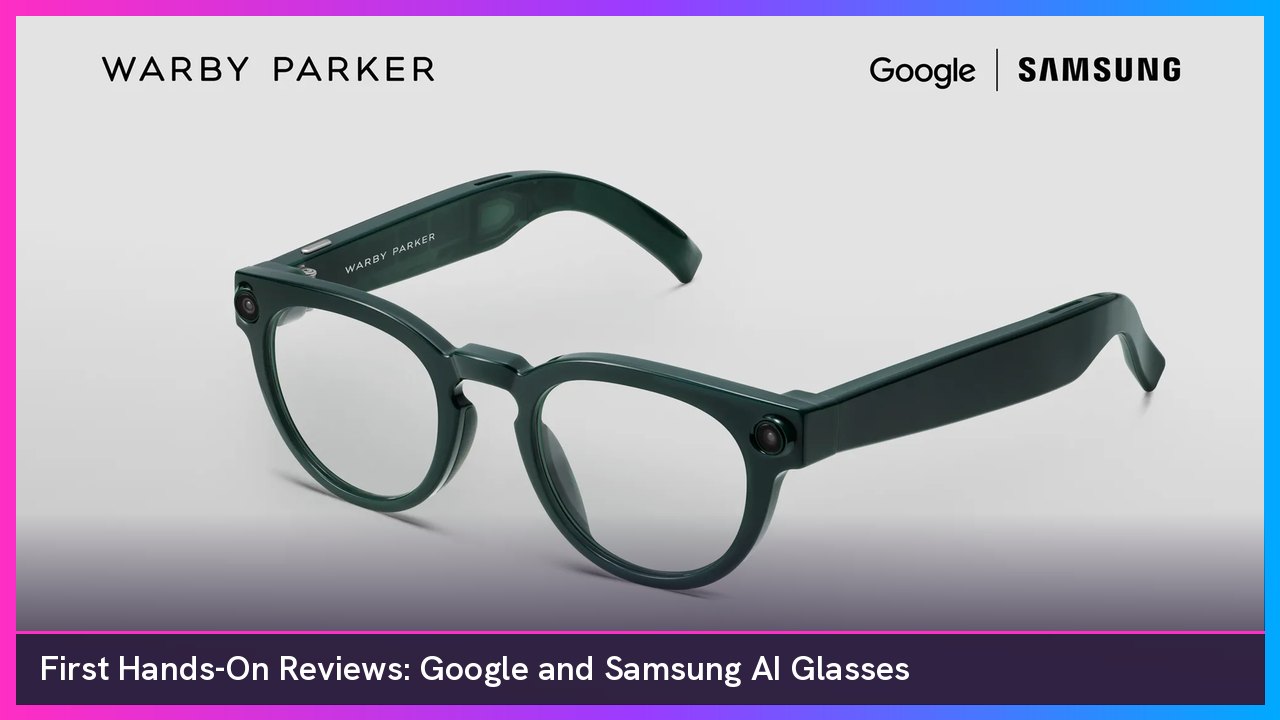
Quick summary: The first hands-on impressions of Google and Samsung’s Intelligent Eyewear landed today, right as pre-orders opened at Warby Parker and Gentle Monster. These are short demos, not week-long reviews, but the early take is pretty consistent: Gemini and live translation impressed people, the frames look like regular glasses, and a lot of the big questions — real-world battery life, all-day comfort, and whether they’re worth the price — are still unanswered.
Key takeaways
- Reviewers from The Verge, Engadget, 9to5Google, Android Authority, Tom’s Guide, and WIRED tried the glasses in controlled demos, not everyday use.
- Most were impressed by Gemini and live translation, and they generally liked the Warby Parker and Gentle Monster designs.
- The glasses have no display. Several reviewers flagged that, along with limited phone support and the starting prices of $395 and $449.
- I couldn’t find a fresh English-language CNET hands-on of the retail frames today. Longer reviews should come once review units go out.
If you want the full specs, prices, and feature list, I already covered that in my prices and features breakdown.
What reviewers liked
Gemini is the headline. The Verge’s Victoria Song says the AI demos were “better than I expected,” and that Gemini on the glasses is, so far, “more capable than Meta AI on the Ray-Bans.” She used it to pull concert details off a flyer, add them to Google Calendar, look up flights, and get walking directions. She also watched Gemini correct itself in real time, or ask for a better view of an object so it could give a more accurate answer.
Engadget’s Sam Rutherford came in skeptical of smart glasses without a screen and left more open to them. He called the glasses “surprisingly full-featured” and said Gemini looked like “the smartest of the bunch” compared with assistants like Siri and Muse. He also noted you don’t need a paid Gemini plan to use the features. Tom’s Guide’s Kate Kozuch liked how Gemini stayed with her through multi-step tasks, like a quick tutorial, without making her repeat a wake word every time.
Live translation stood out. Song tried a messy demo with a TV chef speaking Korean, background conversation, and music in another language — a setup she says tripped up Meta’s Ray-Ban Display glasses on vacation — and said it was “no big deal” here. She didn’t have to pick or download a language pair first. Kozuch called an English-to-Mandarin conversation “the most inherently natural” live translation she’s tried on glasses, phones, or earbuds, even with a bit of delay at the start. WIRED’s Julian Chokkattu said translation “worked remarkably well in my controlled demos, with only a few errors,” and tried to match the speaker’s tone. Rutherford called it “kind of magical.”
The frames look like glasses. 9to5Google’s Abner Li wore them for about an hour and said the Samsung hardware “looks and feels like glasses, almost unremarkably so.” Song found the Warby Parker styles more everyday and Gentle Monster more “editorial and runway-ready.” Kozuch, who already likes Gentle Monster, said some frames looked “even less obviously like smart glasses than Meta’s.” Android Authority’s C. Scott Brown called the 30-minute session “excellent” for comfort and said the frames “never felt warm at all.”
The camera and audio were mostly fine in short tests. Li said early camera impressions were “positive.” Song called the sound “pretty good” and the 12-megapixel photos and video “decent,” with image stabilization straightening tilted shots. Brown said photo and video quality “exceeded my expectations,” in part because the phone does the heavy processing. Kozuch liked the clear vocals when listening to music.
Privacy features got attention, even if the public reaction is still TBD. Reviewers repeatedly mentioned the recording light, tamper detection, face redaction before Gemini processes a scene, and Google’s promise not to use those visuals for training or ads. Song called that “a bold departure from Meta’s approach.” Whether people on the street will treat these any differently than Ray-Ban Metas is another question, and most writers said we’ll have to wait and see.
What they didn’t like, or at least flagged
There’s no display. That’s official, not a surprise, but it still came up. Rutherford still wants glasses with built-in screens, and he noted Google doesn’t have a true rival to Meta’s Ray-Ban Display glasses yet. Brown pointed out that Google has previewed display prototypes, but they won’t ship this year and don’t have a firm launch window. Chokkattu heard the same from Google: display glasses are being tested and remain on the roadmap, with no date.
The software and hardware limits showed up quickly. Brown said you have to explicitly tell Gemini to look at something, or it won’t use the camera. He also noted photos and videos are locked to portrait orientation, with no 16:9 option, and that live translation won’t translate your own voice back to the other person. Voice control for music is limited to YouTube Music, Spotify, Apple Music, and Audible, even if you can still play other audio from your phone like a regular Bluetooth headset. He wouldn’t use these “to seriously listen to music” in place of Pixel Buds Pro 2. Kozuch noticed “quite a bit of sound leakage at higher volumes” in a shared demo space. Li liked the inward privacy light, but it was “distracting” at first.
Phone support is narrow, and the branding is a mouthful. Chokkattu called the limited compatibility “oddly” restrictive: select Pixel, Galaxy, and iPhone models only. A Google spokesperson told WIRED the company plans to say more about expanding support in 2027. Brown called shutting out the rest of Android “disappointing.” Li isn’t sure the “Intelligent Eyewear” name will stick, and expects people to just say Google glasses or Samsung glasses.
The early verdict is split on whether you’d actually buy them. After 30 minutes, Brown wrote that he still couldn’t name one task the glasses handle that his phone, smartwatch, and earbuds can’t already do, “often with better camera quality and control.” The title of his hands-on is blunt: he’s “not sure why I’d buy them.” Rutherford’s caveat is different: the glasses make a better case for always-on AI than most devices he’s used, but “you do have to buy into talking to and relying rather heavily on Gemini,” and he’s “still not sure I’m 100 percent on board with that.” Kozuch’s photos from around Little Island “came out… okay,” and she wouldn’t expect glasses to replace a flagship phone camera.
The open questions: battery, display, comfort, and price
These were short, controlled sessions. Brown’s was 30 minutes. Li’s was about an hour. Kozuch had a few hours. Nobody has published a real everyday review yet, and Brown says review units from both brands are still on the way. That’s the honest state of things today.
Battery. Google rates the glasses at up to nine hours, with a case that can recharge them up to seven times. Brown suspects “hitting the full nine hours will be rare under heavy use.” Kozuch figures frequent camera use will cut into that rating, the same way it does on Meta’s glasses. Nobody has a full-day battery test in print yet.
Display. The current glasses are audio-only, on purpose. Reviewers who wanted captions, navigation, or a screen like Meta’s Display model will have to wait, and Google hasn’t said when.
Comfort. Short sessions went well. Brown noted a practical catch: you can’t heat and bend these stems the way an optician can with regular plastic frames, so a bad fit means exchanging them. Kozuch wants to know how comfort holds up across a normal day, and Li still wants more time to judge whether voice commands are fast enough to be the main way you use them.
Price. Warby Parker starts at $395 and Gentle Monster at $449, before lens upgrades. That’s the official starting point, and several reviewers mentioned it as a hurdle, especially next to the “do I need these?” question. Brown put it plainly: living with the glasses will show whether “hands-free Gemini living on my face truly justifies the price.”
There’s also the cultural issue. Almost every hands-on brought up privacy worries and the ugly “pervert glasses” reputation Meta helped create. Kozuch pointed out the tradeoff: frames that look more like regular glasses are nicer to wear, and harder for other people to recognize as a camera. Song’s conclusion was that the technology isn’t the main problem anymore. “Whether or not this form factor takes off will boil down to culture, privacy, and usefulness.”
My take
I’m glad these exist, and I’m glad a bunch of people finally got to try the real frames instead of prototypes. The through-line I keep seeing is that Gemini and translation might be the reason to pick these over Meta’s glasses, and that the Warby Parker and Gentle Monster designs look like something I’d actually wear. That tracks with what I wanted from this launch.
I’m less worried about the missing display than some of the reviewers are. I already use smart glasses for music, calls, and quick help, and I don’t need a screen on my face for that. The open questions that matter more to me are all-day battery life, whether they stay comfortable, and whether Gemini stays that sharp outside a demo room.
The other thing I keep coming back to is the price and the buying experience. $395 or $449 before lenses is not crazy for this category, but I still want a longer review before I’d tell someone to pre-order. And as I wrote earlier today, it’s still strange that you can’t buy a Google and Samsung product at Google, Samsung, Best Buy, or Amazon.
These first write-ups are promising, not definitive. I’ll be watching for the full reviews once people have actually lived with them.
Meta glasses you can buy today
Google and Samsung’s Intelligent Eyewear is available to pre-order, but it doesn’t arrive until December 10. If you want AI glasses you can buy right now, Meta’s lineup is in stock. I checked meta.com on November 12: Ray-Ban Meta Wayfarer (Gen 3) starts at $449, the Meta Ray-Ban Display with Neural Band starts at $799, and Oakley Meta Vanguard starts at $499. Ray-Ban Meta Wayfarer (Gen 1) and Skyler (Gen 1) are on sale from $224 (was $299). Use promo code GREGGLESTV at checkout on Meta’s site. The Gen 1 Wayfarer is also at Best Buy.
- Ray-Ban Meta Wayfarer (Gen 3) at Meta, from $449
- Ray-Ban Meta Wayfarer (Gen 1) at Meta, sale from $224 (was $299)
- Ray-Ban Meta Skyler (Gen 1) at Meta, sale from $224 (was $299)
- Meta Ray-Ban Display + Neural Band at Meta, from $799
- Oakley Meta Vanguard at Meta, from $499
- Ray-Ban Meta Wayfarer (Gen 1) at Best Buy
Sources
- The Verge: I tried Google’s AI glasses and Meta’s finally got real competition
- Engadget: The first batch of Android XR smartglasses made me rethink my stance on specs without displays
- 9to5Google: Hands-on: Google and Samsung’s vision for Android XR glasses is 20/20
- Android Authority: I tested Google’s $395 Intelligent Eyewear smart glasses — I’m not sure why I’d buy them
- Tom’s Guide: I tried Google’s answer to Meta glasses from Warby Parker and Gentle Monster
- WIRED: Google and Samsung’s Android XR Smart Glasses Are Finally Here
Subscribe to GregglesTV for daily tech news, reviews and walkthroughs.
See today’s GregglesTV Best Tech Deals or browse all deals posts.


Comments
Comments are moderated. Hate, slurs, spam and scam posts are blocked. Don’t include personal info you wouldn’t want public. See the privacy policy.
Loading comments…